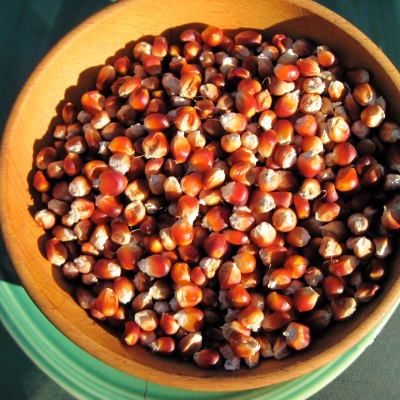
Zea mays var. rostrato (100 days) Open pollinated. Beautiful red pointy kernels are easy to shell and grind. Rich sweet corn flavor good for flour or polenta.
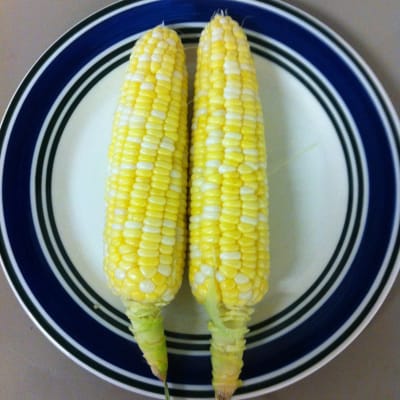
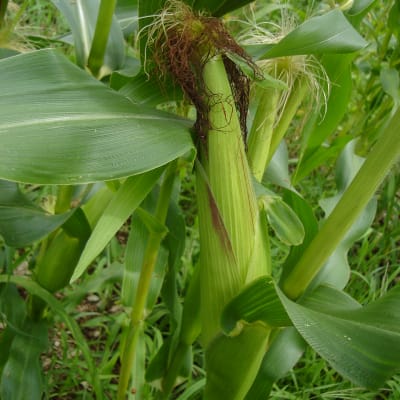
Zea mays (72 days) Open pollinated. Bred by Fred Ashworth. 5' stalks, 6-7" yellow ears, good flavor. Harvest at milk stage; does not hold in the field. Starts well in cool soil.
Cucumis sativus (60 days) Open pollinated. Parthenocarpic pickler. Blocky, smaller than average fruit. Compact growth and small leaves. Can be grown under row cover.
Cornus racemosa 3-8' x 10-15'. Native multi-stemmed thickly branched suckering shrub with rounded domes of small 4-petaled white flowers that bloom in early summer. White berries on bright red fruit stalks. Z4.
Cornus alternifolia 20' x 30-35'. Small tree or large multi-stemmed shrub with tiers of horizontal branches and fragrant white 2-3" flower clusters. Z3.
Hordeum vulgare Annual spring grain. Truly hulless variety, which makes for quick, easy, low-tech processing. Fast-growing, and competes well with weeds. Tolerates drought and heavy soils.
Echinochloa frumentacea Annual grass. Vigorous and versatile! Good for hay, forage, weed-smothering, building soil, and controlling erosion. Tolerates waterlogged soils, low fertility and cool conditions.
Phleum pratense Perennial grass. A popular perennial hay species that produces good yields, resists lodging and is easily cut and cured. Very winter hardy. Does not tolerate heat or drought.
Gladiolus murielae 12-18" tall. Sword-like foliage is topped by wonderfully scented star-shaped white flowers with mahogany-purple centers on arching stems. Beautiful in the garden or as a cutflower. Z7.
Pennisetum glaucum (120 days) Open pollinated. Ornamental grass with deep-purple foliage and large purple seed spikes. Popular in arrangements. 4-5' tall.
Pennisetum glaucum (120 days) Open pollinated. Ornamental grass with deep-purple foliage and large purple seed spikes. Popular in arrangements. 3-5' tall.
Lupinus mutabilis (130 days, longer to seed) Open pollinated. “Lost” crop of the Incas. Wild-looking 3' lupine native to the high Andes. Attractive, many-colored flowers. Protein-rich seeds.
Open pollinated. Two packets: one mixed lettuces, one mixed greens. Plant lettuces first, then greens for fabulous salad mixes. Cut then water, and they grow again.
Cichorium intybus (80 days) Open pollinated. Italian heirloom grown for its fused stems which form a swollen bulb. Sweet stalks eaten in salad or cooked.
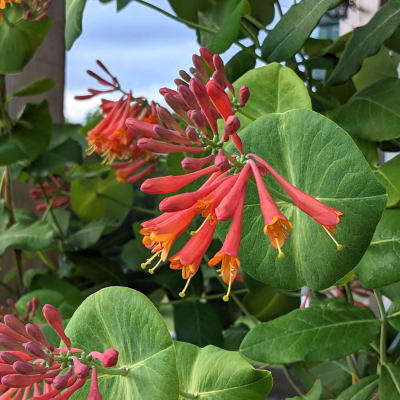
Lonicera × brownii 10-20'. Tall climbing honeysuckle. Non-invasive! Attractive to pollinators, especially hummingbirds. Species is native to North America. Z3.
Brassica oleracea (acephala group) (61 days) Open pollinated. Florida heirloom. After frost, develops beautiful white ribs that contrast with yellow-green leaves.
Brassica oleracea (acephala group) (62 days) Open pollinated. Italian heirloom also known as Lacinato and Tuscan Black. Very dark green wrinkled, pebbled sturdy leaves extend like palm fronds from stalk.
Brassica oleracea (gongylodes group) Green skin, white flesh. (58 days) Open pollinated. Central European heirloom. Green kohlrabi with short tops and medium stems. White interior is crisp, tender, pungent.
Brassica oleracea (gongylodes group) Green skin, white flesh. (45 days) F-1 hybrid. Very early consistently high-quality green kohlrabi. Tender with sweet flavor.
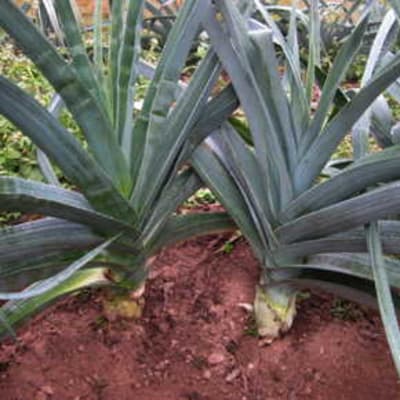
Allium ampeloprasum (porrum group) (84 days) Open pollinated. 6" tall, 3" thick shanks. Blue-green leaves. Very cold tolerant. A good candidate for overwintering.
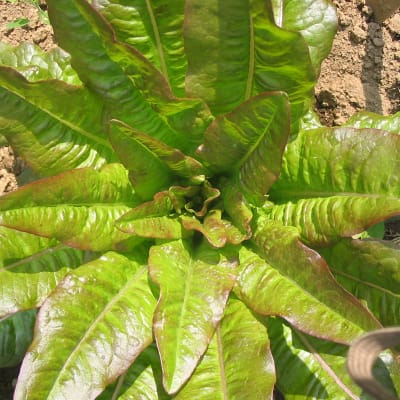
Lactuca sativa (48 days) Open pollinated. Hefty wine-red Batavian forms open rosette that folds together like a romaine at maturity. Shiny red leaves, green in the center, good for baby leaves.
Lactuca sativa (48 days) Open pollinated. Compact tight uniform heads form upright rosettes for a clean market and salad harvest. Pebbled leaves shaded red and light plum on a green base.
Lactuca sativa (52 days) Open pollinated. Large fancy fast-growing light-green butterhead lettuce. Bolts quickly in heat. Recommended for fall or overwintering where climate permits.
Lactuca sativa (50 days) Open pollinated. Rare. Starlike rosettes of glossy deer tongue-type leaves are tinged burgundy-red. Nutty texture and bitter-free. Very bolt resistant.
Lactuca sativa (55 days) Open pollinated. Dense oakheart heads range from mini to full to elf-eared. Variations in this gene pool range from deepest solid red to the heart, red spotting, speckling and blushing, to spotless green.
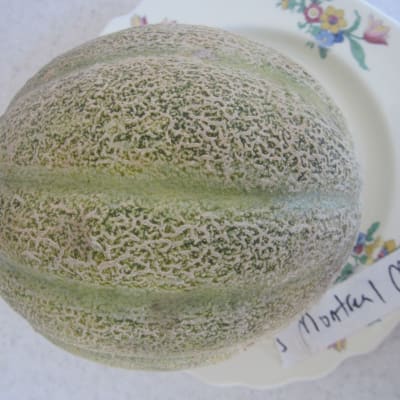
Cucumis melo Green flesh. (89 days) Open pollinated. Green-fleshed heirloom, once the most widely grown in Canada, New England. Netted and ribbed fruits with aromatic silky texture. Can get quite large.