If thoughts of crisp carrots in March set your mouth watering, you'll love this well-illustrated tour of root cellar designs, featuring varietal selections, best storage conditions, and recipes.
Beta vulgaris (54 days) Open pollinated. Gene pool based on 3 heirlooms. Expect 3 colors: pink-red with orange, bright gold and vivid orange. 3.5 x 7-8" tapered form.
With plenty of scientific detail and practical knowledge about a variety of regenerative practices, Phillips reveals how mycorrhizal fungi are deeply embedded in healthy soils and plant physiology.
Raphanus sativus var. niger Broadleaf annual. Roots penetrate hardpans and loosen soil down to 30" or beyond. Takes up available soil nutrients and prevents losses to leaching or runoff. Suppresses weeds if planted thickly.
Raphanus sativus var. niger Broadleaf annual. Roots penetrate hardpans and loosen soil down to 30" or beyond. Takes up available soil nutrients and prevents losses to leaching or runoff. Suppresses weeds if planted thickly.
A powerful soil restoration amendment! Supports plant health and increases yields by facilitating roots’ uptake of plant nutrients and water. Improves levels of carbon and humus.
Beta vulgaris (54 days) Open pollinated. Gold beet with Lutz shape, size and mild sweet flavor. Green tops with some golden stem. Golden orange roots with orange shoulders.
Apium graveolens var. rapaceum White flesh. (95 days) F-1 hybrid. Slightly oblong 3–4" roots have nice mild flavor and dense white interiors that resist hollow heart and pithiness.
Echinacea purpurea 3-5' tall. Spiny seedheads are a beautiful coppery yellow-brown, surrounded by a single row of reflexed lavender-purple petals. Tinctured roots boost the immune system. Z3.
Acorus americanus 24-36" tall. Water-loving bog plant with broad sword-like foliage that smells sweetly of citrus and vanilla when crushed. Roots traditionally used as an aromatic bitter for digestive upsets. Z3.
Made in the U.S. from cow manure and a bit of recycled newsprint, nourishes the plant as it decomposes. Roots can grow right through the walls of the pot. 3" round, 3¼" tall
Made in the U.S. from cow manure and a bit of recycled newsprint, nourishes the plant as it decomposes. Roots can grow right through the walls of the pot. 3" square, 3" tall.
Made in the U.S. from cow manure and a bit of recycled newsprint, nourishes the plant as it decomposes. Roots can grow right through the walls of the pot. 4" square, 4⅜" tall.
Made in the U.S. from cow manure and a bit of recycled newsprint, nourishes the plant as it decomposes. Roots can grow right through the walls of the pot. Six-packs of 3" squares, 3" tall.
Arctium lappa (120 days) Open pollinated. Standard Japanese variety. Thin 1-2' long mild earthy root for stir-fries, soups and herbal medicine. Can be dug in spring with parsnips.
This long-handled weeder is plenty strong but light as a feather, and makes quick work of small weeds, slicing the stem from the root just below the soil surface. Made in Vermont by Two Bad Cats.
Ageratina altissima Open pollinated. Flat-topped fuzzy clusters of small pure white disk flowers bloom August through October, attracting multiple species of bees, moths and butterflies.
Formulated to build humus, enhance CEC, and condition the soil in which the ancient roots reside, whether they be abandoned heirlooms or wild seedlings. Can be applied in fall or spring.
Humic acids perform many complex functions. They neutralize soil pH, prevent leaching of trace minerals, stimulate growth of foliage and roots significantly, and much, much, more!
Beta vulgaris (60 days) Open pollinated. Grown for greens, not roots. Large glossy reddish-purple leaves. Holds quality in summer but best in fall and under winter cover.
Beta vulgaris (60 days) Open pollinated. Grown for greens, not roots. Large glossy reddish-purple leaves. Holds quality in summer but best in fall and under winter cover.
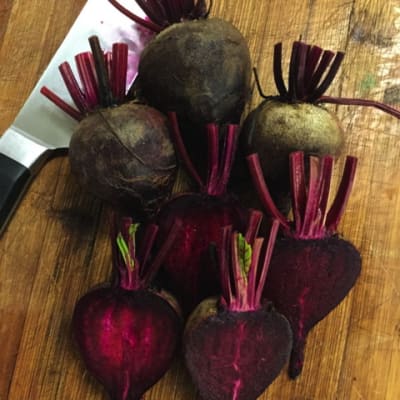
Beta vulgaris (53 days baby; 85 days full size) F-1 hybrid. Baby bunching beet or full-size storage beet. Smooth dark red roots with excellent sweet flavor.
Mycorrhizae form beneficial relationships with the roots of most plant species: they boost plant growth by improving the roots’ ability to take up nutrients, water and oxygen.
Daucus carota (55 days) Open pollinated. Early coreless translucent pinkish-orange blunt-tip roots. Mild sweetness boosted by “carrot perfume.” Upright tops good for bunching.
Daucus carota (55 days) Open pollinated. Early coreless translucent pinkish-orange blunt-tip roots. Mild sweetness boosted by “carrot perfume.” Upright tops good for bunching.
Daucus carota (68 days) Open pollinated. Uniform cylindrical 7" roots with unusually good interior color, crisp texture and fine flavor. Holds well; an excellent keeper too.
Daucus carota (85 days) Open pollinated. A stalwart storage carrot whose flavor improves with time. Also good for fresh eating and juicing. 7–9" heavy cylindrical roots.
Apium graveolens var. rapaceum White flesh. (100 days) Open pollinated. A classy early celeriac, high yielding with relatively smooth roots, uniform white internal color and splendiferous eating quality.
With annuals and biennials, grasses and legumes and broadleafs, and roots of all shapes and sizes, this blend mimics natural diversity and encourages a flourishing and balanced microbial population.
Secale cereale Winter annual grass. Extremely frost hardy, adaptable and competitive. For cover crop or grain. Deep extensive roots help prevent compaction and improve soil tilth. Vigorous spring regrowth.
Safe, nontoxic, easy to use hydrogel formulation absorbs and holds water. The swollen crystals adhere to plant roots, reducing transplant shock. Useful for garden seedlings as well as woody plants.
Rubia tinctorum Open pollinated. Ancient and excellent source of red dye. Harvest roots after three years and grind to yield a wash- and light-fast red dye par excellence. 4' plants.
Saponaria officinalis Open pollinated. Not a dye plant; saponin-rich roots and leaves used to gently wash wool. Sweetly clove-scented pink perennial attracts pollinators. 3' plant.
Withania somnifera Open pollinated. Upright shrub 2' with green-to-yellow flowers ripening to red berries. Roots are dried at the end of the growing season and used internally powdered or tinctured.
Raphanus sativus Rosy pink skin, white flesh. (25 days) Open pollinated. Rosy-pink color with bright white flesh, crisp and mild. Oblong plump roots hold longer than others without cracking or getting soft and pithy.
Raphanus sativus Red skin, white flesh. (23 days) Open pollinated. A classic, done well. Impressively heat tolerant; roots can become quite large while maintaining round shape and resisting pithiness.
The beveled sharpened edges of this blade separate weeds from their roots just below the soil surface. Minimizes soil disturbance and reduces likelihood of allowing more weed seeds to germinate.
An essential tool for dealing with small and large weeds . Slices through the weeds’ roots without needing you to bend over or exert much downward pressure. Great for footpaths and wide rows.
An essential tool for dealing with small and large weeds . Slices through the weeds’ roots without needing you to bend over or exert much downward pressure. Great for footpaths and wide rows.