Allium cepa Open pollinated. Long day. Bright crystal white orbs. Good for bunching onions, or uniform round slicers. Very sweet, great for fresh eating.
read more
Clarkia amoena (90 days) Open pollinated. 3" “satin flowers” blooms in red, pink, salmon, lavender and white, and with a bright red patch in the heart of the four petals. Best for cutting.
read more
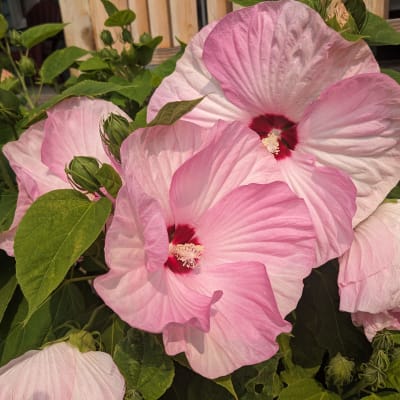
Hibiscus moscheutos Open pollinated. Perennial, Zones 5-9. 6-8" saucer-shaped flowers in a mix of pinks, red and white, with contrasting red eyes where a contrast is to be had.
read more
Talinum paniculatum (95 days) Open pollinated. Petite pink flowers on thin stems mature into airy glistening bronze-to-burgundy sprays of teensy seedpods. Annual.
read more
Coix lacryma-jobi (100 days) Open pollinated. Sets pendulous sprays of globular pearly purple-grey seeds, which may be strung as beads for necklaces. Spiky 2–3' stalks good for planters or as filler in dried fall arrangements.
read more
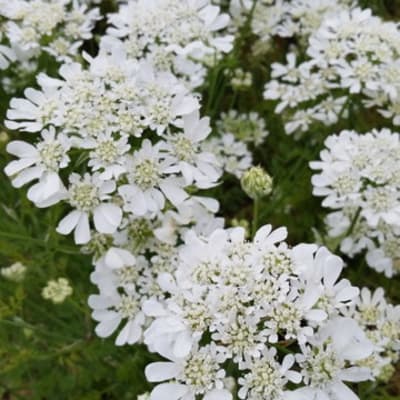
Orlaya grandiflora (65-70 days) Open pollinated. 2-3' with ferny foliage and sturdy stems, dainty delicacy resembling lace-cap hydrangea, with the central florets of a flat-topped cluster surrounded by a ring of larger flowers.
read more
Rubia tinctorum Open pollinated. Ancient and excellent source of red dye. Harvest roots after three years and grind to yield a wash- and light-fast red dye par excellence. 4' plants.
read more
Reseda odorata Open pollinated. Insignificant yellow-green blossoms grown for their enticing raspberry scent. Once common in Paris. Compact plants.
read more
Sempervivum Low-growing rosette-forming succulents produce runners and babies. Drought and heat tolerant. Cold-hardy too! Colorful mix of reds, greens and purples. Z3.
read more
Ageratina altissima Open pollinated. Flat-topped fuzzy clusters of small pure white disk flowers bloom August through October, attracting multiple species of bees, moths and butterflies.
read more
Artemisia annua (120 days) Open pollinated. The scent of the Common Ground Fair. Light green leaves valued for wreaths, flower crowns and other dried arrangements. Grows up to 5'.
read more
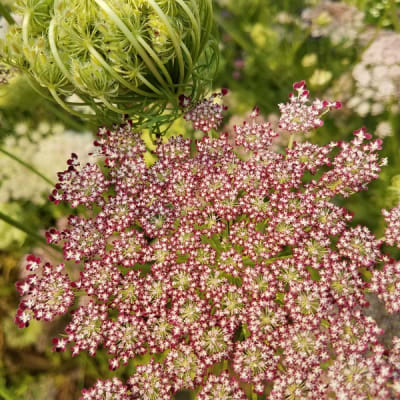
Pimpinella anisum (130 days) Open pollinated. White umbel flowers in July have delicate ornamental value. Seed ripens in August and September—wait until the tips of the fruits turn grey, and collect seeds before they turn black.
read more
Withania somnifera Open pollinated. Upright shrub 2' with green-to-yellow flowers ripening to red berries. Roots are dried at the end of the growing season and used internally powdered or tinctured.
read more
Codonopsis pilosula Open pollinated. Perennial to Zone 4. Used in Chinese medicine like ginseng, but considerably easier to grow than true Panax ginseng.
read more
Dysphania ambrosioides (55 days) Open pollinated. Culinary herb native to Central America, often added to beans to deepen flavor and to mitigate flatulence. Sharp and pungent.
read more
Trigonella foenum-graecum (30 days leaf, 120 days seed) Open pollinated. Leaf and seeds are used culinarily, imparting a sweet nutty flavor reminiscent of maple syrup. If not pinched back, the plant will
read more
Silybum marianum Open pollinated. Named for the bold white splashes on its glossy leaves, said to be from Mary’s milk. Fast-growing 3-5' annual with leaves up to 8x24".
read more
Mentha pulegium Open pollinated. Perennial. Hardy aromatic ground cover; plants creep with only the lavender flower stalks rising above the ground.
read more
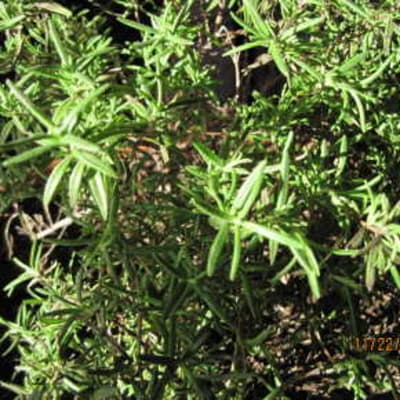
Rosmarinus officinalis Open pollinated. Beloved tender perennial growing to 3-4'. Cannot withstand temperatures below 17°, may be overwintered indoors if kept cool and moist.
read more
Spilanthes oleracea Open pollinated. Used as a ground cover in the south, it adds unusual beauty with its low growth habit and its cute yellow flowers with rayless red-orange centers.
read more
Spilanthes oleracea Open pollinated. Used as a ground cover in the south, it adds unusual beauty with its low growth habit and its cute yellow flowers with rayless red-orange centers.
read more
Matricaria recutita Open pollinated. One of the most widely known herbs, powerful yet gentle, long used to promote relaxation. Perhaps a tad less sweet than others.
read more
Gaylussacia baccata 1-3' x 2-4'. Cousin of the blueberry. Less acidic, more mildly sweet flavor. Flowers in June, fruits in August. Full sun to part shade but fruits best in sun. Native to eastern U.S. and Canada. Z3/4.
read more
Calycanthus floridus 6-10' x 6-12'. Beautiful native shrub with dark burgundy-maroon flowers and shiny leaves. Blooms early, flowers through summer. Highly fragrant. Z4/5.
read more
Myrica pensylvanica 5-10' x same. A common sight along Maine’s rocky shores. Fragrant glossy deep green leaves and small waxy berries. Fixes nitrogen and feeds wildlife. Z2.
read more
Cephalanthus occidentalis 6-10' x 8'. Loose rounded branchy shrub with masses of ornamental blooms that appear 4–6 weeks in summer. Attractive to pollinators. Z4.
read more
Prunus glandulosa 5-6' x 3-4'. An early spring spectacle of pink double flowers. Branches are nearly covered with the impressive blooms ranging all shades of pink. Z4.
read more
Lindera benzoin 6-12' x 8-12'. Large rounded multi-stemmed fragrant native shrub suited to moist or wet areas. Soft-yellow flowers. Glossy red edible berries. Z5.
read more
Spiraea tomentosa 2-4' x same. Adorable little plant. Rosy pink steeples emerge as terminal spikes about 4–6" tall. Easy to grow. A must for every butterfly garden. Z3.
read more
Gaultheria procumbens 6-10". Aromatic evergreen native groundcover. Glossy dark green leaves. Bell-shaped white flowers in June. Vivid red berries. Self-pollinating. Z3.
read more
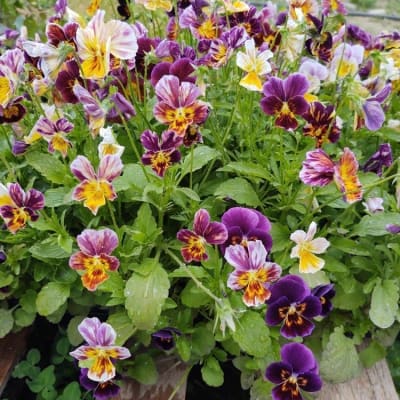
Viola cornuta Open pollinated. Large fragrant flowers in purple, pink, yellow and light blue striped with white and yellow strokes. Dwarf 6" plants.
read more