Prunus avium Summer. All-around excellent sweet cherry for the Northeast. Sweet light-colored flesh. Good size, great flavor and heavy cropping. Disease and crack resistant. Self-pollinating. Z4.
read more
Slipped over your forearms and gloves, the heavy close-woven canvas protects you from the cuts of rose thorns, thistle spines and other prickly peril, without restricting arm motion or circulation.
read more
Abies balsamea 45-75'. Native conifers with fragrant boughs used for wreaths. The best Christmas tree! Semi-shade tolerant. Good hedge tree. Z3.
read more
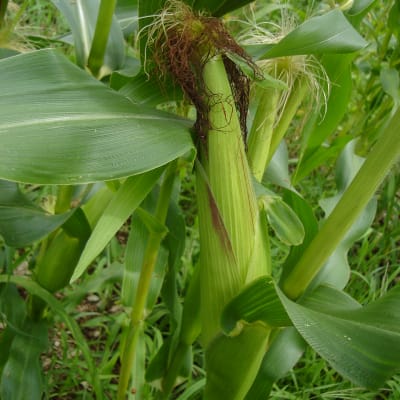
Zea mays (68 days) Synergistic F-1 hybrid. Early fancy tip-filled 8" ears. Quality and flavor like a late corn. Good cold-soil emergence. Often a single ear per stalk.
read more
Zea mays (75 days) Supersweet F-1 hybrid. Bicolor, 8" ears, 16-18 rows of crisp but tender kernels. Holding quality in the field and after harvest is superb.
read more
Zea mays (72 days) Open pollinated. Bred by Fred Ashworth. 5' stalks, 6-7" yellow ears, good flavor. Harvest at milk stage; does not hold in the field. Starts well in cool soil.
read more
For building tunnels with slitted plastic or fabric row covers. Shipped as straight 74" flexible rods of 10-gauge wire that can be stuck in the ground and bent into your desired hoop width.
read more
Cucumis sativus (58 days) Open pollinated. Slicer from the same line as Marketmore 76. Fruit is slimmer and darker, with improved yield and disease resistance.
read more
Cucumis sativus (63 days) Open pollinated. Maine heirloom. 3-4" short plump oval cream-white fruit with black spines. Excellent fresh eating.
read more
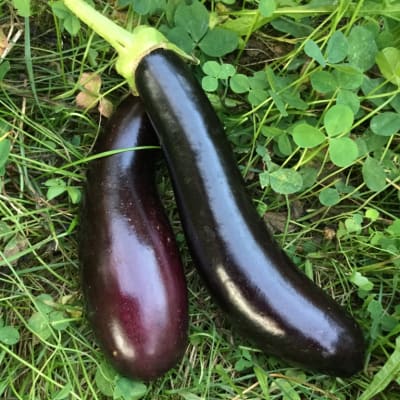
Solanum melongena (60 days) F-1 hybrid. This long 7x2" dark purple Italian “sword” is great for cooks who like uniform slices. Flavor is smooth and mild with no bitterness.
read more
Trifolium repens Perennial legume. 8–12" tall. Fantastic nitrogen fixer with great protein and digestibility. Tall enough to be harvested for hay, silage, and green chop. Good choice for poorly drained soil.
read more
Lolium multiflorum Annual or winter annual grass. Extremely frost hardy. Widely adaptable. Will establish quickly in cool wet spring weather, providing a dense cover crop and outcompeting weeds. Good erosion control.
read more
Lolium multiflorum Annual or winter annual grass. Extremely frost hardy. Widely adaptable. Will establish quickly in cool wet spring weather, providing a dense cover crop and outcompeting weeds. Good erosion control.
read more
Diverse multispecies clover-heavy mix is great as a soil-building living mulch under tall-growing competitive crops, like cannabis. Suitable in raised beds, containers and high tunnels.
read more
This dynamic cover crop duo has become a favorite of growers who value its vigorous growth and soil-building prowess, along with the assurance that it will winterkill up North.
read more
Brassica juncea or Sinapis alba Annual broadleaf. Great cover crop to retain nutrients, suppress weeds and improve water penetration. Breaks down into compounds toxic to nematodes and soil-borne pathogens.
read more
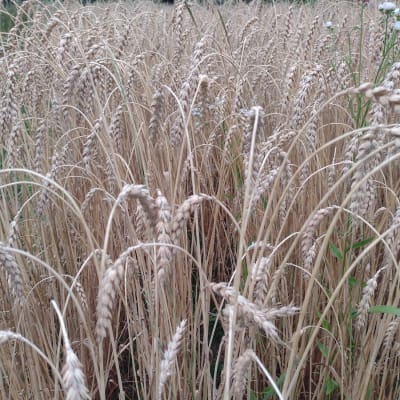
Triticum aestivum Winter annual grain. Extremely cold hardy hard red wheat. Flour has great flavor and texture, and sturdy plants make great straw. Good for small spaces. Well adapted to New England. Will Bonsall fave!
read more
With 26 full-page illustrations (including covers), our exclusive coloring book features some mash-ups you might recall from past catalogs, and some brand-new ones, for an all-ages coloring fun fest.
read more
Foeniculum vulgare (72 days) Open pollinated. Nearly as bolt proof as those pricey hybrids seven times the cost and 5-7 days longer-standing than Zefa Fino, with much thicker bulbs.
read more
Gaillardia pulchella Open pollinated. Daisy-type flowers in reds, yellow, rust and orange with a prominent colored center. Free flowering, low maintenance and easy to grow. Attracts butterflies. Good cutflower.
read more
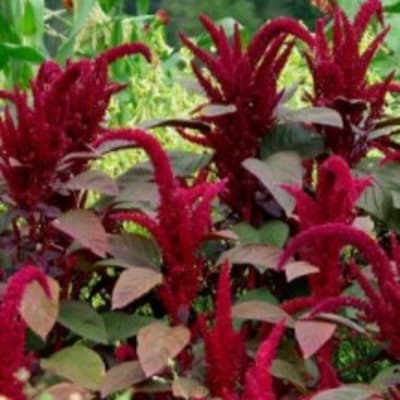
Amaranthus hybridus (65 days to flower, 125 days to seed) Open pollinated. Is it a green vegetable? An ornamental? A gluten-free grain? Why, yes! No wonder Amaranth was sacred in pre-Columbian Mexico.
read more
Lupinus mutabilis (130 days, longer to seed) Open pollinated. “Lost” crop of the Incas. Wild-looking 3' lupine native to the high Andes. Attractive, many-colored flowers. Protein-rich seeds.
read more
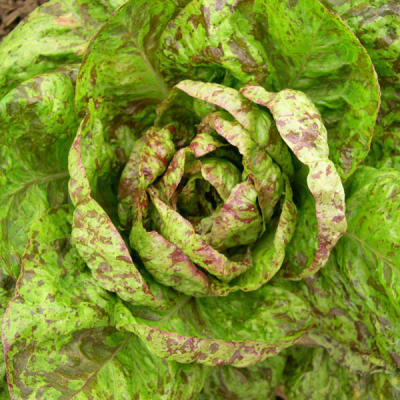
Cichorium intybus (80 days) Open pollinated. White-veined leaves turn from green to variegated burgundy red in cool weather. Romaine-shaped heads. Best for fall crops.
read more
Montia perfoliata (40 days) Open pollinated. Small, heart-shaped leaves with a mild but succulent flavor. Use in mesclun and cut-and-come-again culture.
read more
Valerianella locusta (60 days) Open pollinated. Heirloom. Vigorous large-leaf type of staple salad green. Best for sowing in spring for early summer harvest.
read more
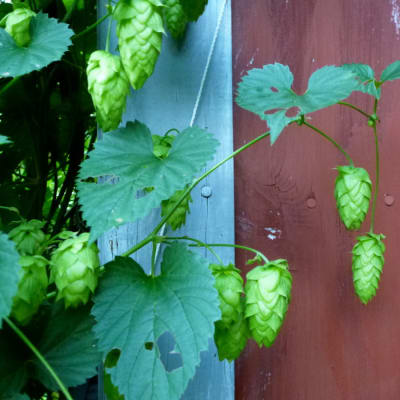
Humulus lupulus Late summer. Fragrantly aromatic hops, low bittering value. Very productive with large cones, ready to harvest mid-late August in central Maine. Z3.
read more
Brassica oleracea (acephala group) (60 days) Open pollinated. Smooth glossy “greasy” greens are delicious steamed. Most delectable early in the season, or late after a nip of frost.
read more
Lactuca sativa (51 days) Open pollinated. Combination of Batavian and romaine, with whorling thick succulent medium-green leaves. Tolerant of heat and rarely bitter.
read more
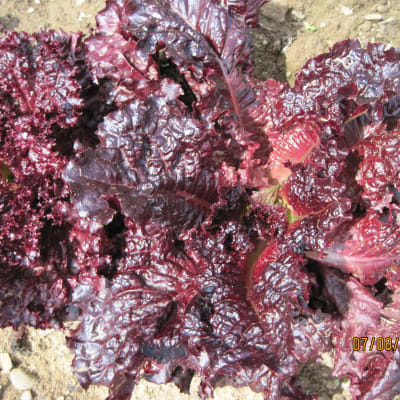
Lactuca sativa (48 days) Open pollinated. Compact tight uniform heads form upright rosettes for a clean market and salad harvest. Pebbled leaves shaded red and light plum on a green base.
read more
Lactuca sativa (52 days) Open pollinated. Large fancy fast-growing light-green butterhead lettuce. Bolts quickly in heat. Recommended for fall or overwintering where climate permits.
read more
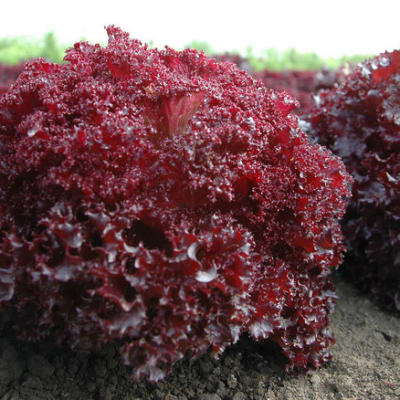
Lactuca sativa (56 days) Open pollinated. Beautiful compact Lollo-type has extremely dark purple-red leaves with ruffles and curls. Very mild flavor for type. Stays non-bitter longer.
read more
Lactuca sativa (54 days) Open pollinated. Beautiful troutback/oakleaf cross, with rich lime-green oakleaves showing dark speckles. Excellent flavor and texture.
read more
Lactuca sativa (67 days) Open pollinated. Deep dark red leaves with contrasting pink veins, and a smidgen of green in the center. Tall upright 8" heads.
read more