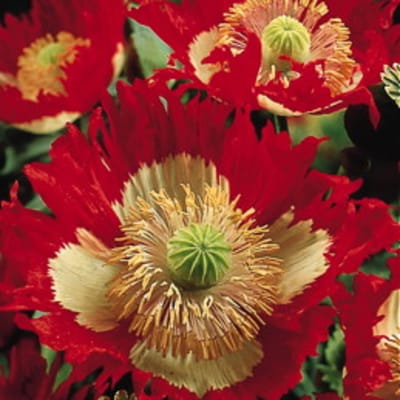
Papaver orientale 20-30" tall. Surely named after one of the three Greek Graces, Aglaea, which means something like ‘festive radiance.’ Royal Horticultural Society’s Award of Garden Merit. Z3.
Papaver orientale 10-15" tall. Dusky damson-plum–colored blossoms. A short version of the original Patty’s Plum poppy, a compost-pile surprise discovered in the 1990s. Z3.
Solanum tuberosum Early to mid-season, blue skin, yellow flesh. Round sapphire exterior creates a striking contrast with stunning gold flesh. High yielding. Also known as Peter Wilcox.
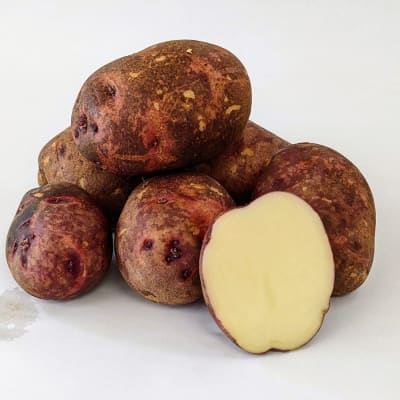
Solanum tuberosum Mid-season, pink-splashed purple skin, white flesh. For size, style, yield and taste, it's an all-around winner. Show-stopping colorful skin and creamy rich flesh. Delicious baked, roasted or mashed.
Solanum tuberosum Multi-colored skin. For those with limited space and an expansive palate, this collection of three varieties includes 2# each of an early, a midseason and a fingerling potato.
Solanum tuberosum Mid to late season, red skin, red flesh. Plump fingerlings with smooth skin, excellent color retention and high yields. They’re also tasty as heck!
Solanum tuberosum Mid-season, red skin, pinkish flesh. Intense bright skin, moist firm flesh that's rich in antioxidants. Released by Cornell in 2008 and qualified as “heirlooms-to-be” by Gourmet.
Solanum tuberosum Mid-season, bright red skin, white flesh. Flesh is firm, sweet and moist, with good storage. Generally good yields of medium-to-large tubers. Developed specifically for blight and scab resistance.
Solanum tuberosum Very late season, russeted brown skin, white flesh. Known to most as the Idaho Potato, the dry mealy texture makes it a trusty old favorite. A great baking or mashing potato. Its reliably high yields mature late in the season.
Solanum tuberosum Late season, buff skin, white flesh. Easy to grow with a solid yield, delicious Elba keeps solidly all winter long, despite slow spring emergence.
Solanum tuberosum Very early season, buff skin, white flesh. The earliest of the early. Mid-sized to large round tubers with a floury texture (good for mashing and baking). Stores quite well for such an early potato.
Solanum tuberosum Mid-season, yellow skin, deep yellow flesh. Medium-large oblong potatoes are on the waxy side and hold their shape in potato salad. Fabulous new potatoes. Said to have the lowest glycemic index of any potato.
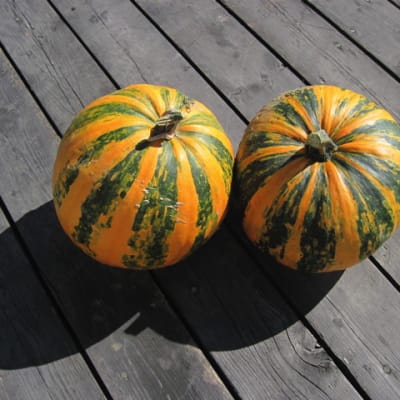
Cucurbita pepo Green-streaked orange skin. (110 days) Open pollinated. Plentiful plump dark brown hulless seeds show a good balance of mild nuttiness and underlying rich earthy potency. Feed yourself, your animals and your chickens all winter and spring!
Cucurbita maxima Orange skin. (120 days) Open pollinated. Extra-large squash-pumpkin. Deep orange 50-100 lb fruit. Up to 70" around. For massive jack o' lanterns, and for showing off.
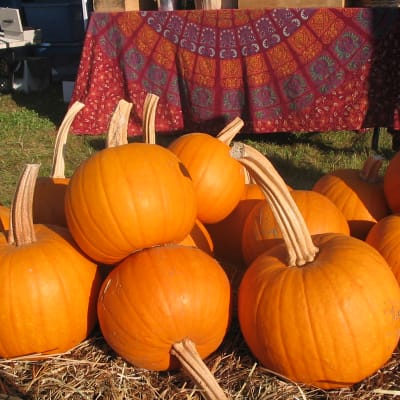
Cucurbita pepo Very deep orange skin. (105 days) F-1 hybrid. Very deep orange, slightly flattened 9x12" 15 lb ribbed pumpkin with a thick solid handle. Great for carving.
Cydonia oblonga Golden yellow skin, light yellow flesh. 10-25'. Hardy Russian quince bred for disease resistance. For jellies and cider, stews and marmalades. Citrusy, fragrant with an orangey-pink hue. Z4/5.
Cydonia oblonga Golden yellow skin, white flesh. 10-25'. Large smooth light golden-yellow fruit with tart white flesh. Good for fresh eating, wine and pineapple-flavored jelly. Late bloomer ripens in late summer. Z4.
Cydonia oblonga Golden yellow skin, light yellow flesh. 10-25'. Oblong furrowed pear-shaped fruit with golden-yellow skin and mild light yellow flesh. Pink flowers. Good keeper. Ripens late summer to early fall. Z4/5.
Raphanus sativus Red skin, white flesh. (23 days) Open pollinated. A classic, done well. Impressively heat tolerant; roots can become quite large while maintaining round shape and resisting pithiness.
Raphanus sativus White skin, white flesh. (30 days) Open pollinated. Heirloom. Slender 4-6" long white radish of high quality. Harvest young. Recommended for home gardens.
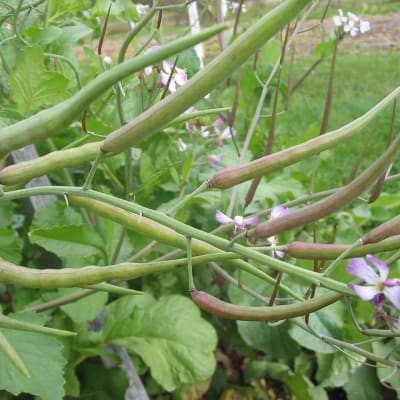
Raphanus sativus var. caudatus (50 days) Open pollinated. Asian heirloom, Specialty. Grown for its immature purple-green pungent seed pods. Harvest young for best quality.
Rosa gallica 2-4' x 3-4'. Low-growing rose with strongly scented double flowers. Crimson buds open pink and gradually turn violet then soft silvery grey. Nearly thornless. Z4.
Rosa alba 5-6' x same. Classic alba variety with clusters of white fragrant highly double 2–3" blossoms, sometimes with more than 200 petals per flower! Z4.
Rudbeckia hirta Open pollinated. With this stunning array of single and double blooms in raspberry, pink, yellow and copper, you'll have lovely bouquets and feast for the pollinators from midsummer to frost.
Rudbeckia hirta (86 days) Open pollinated. Bright 4" golden-orange blooms with deep-set brown eyes. Long strong stems set on 24-30" plants make this an outstanding cutflower.
Rudbeckia hirta (88 days) Open pollinated. Very large and distinctive. Pointy golden petals with light yellow tips. Branching 24-30" plants have long stems, ideal for cutflowers.
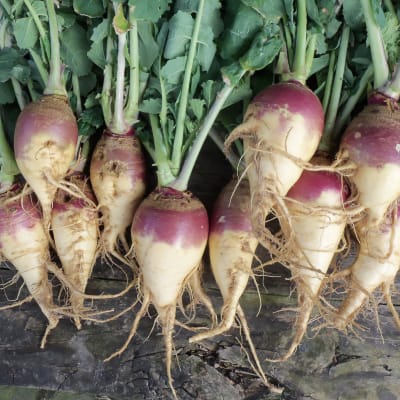
Brassica napus Purple-shouldered cream skin, pale yellow flesh. (95 days) Open pollinated. Canadian origin. Uniform 5-6" almost neckless rutabaga with deep purple crown and cream-yellow base. Sweet pale yellow flesh.
Brassica napus × Brassica rapa (pekinensis group) Purple-shouldered white skin, yellow flesh. (95 days) Open pollinated. A cross between Chinese cabbage and rutabaga, has very fine-grained tasty yellow flesh. Exterior much like purple-crowned Laurentian rutabaga.
Salvia viridis Open pollinated. White and blue flowers set off by large pink-to-purple bracts. Leaves entirely green. Remains colorful when dried. 18" stalks.
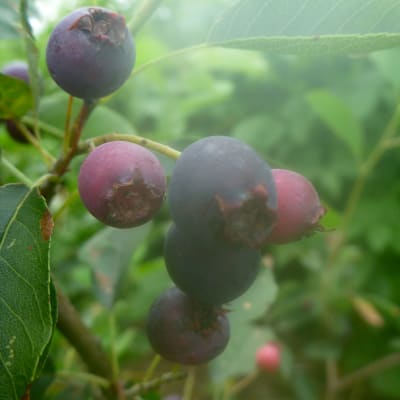
Amelanchier stolonifera 3-5' x same. Berries are small but very flavorful—perfect combo of sweet and tangy. Would do well in a rock garden, hedge or thicket. Native. Z4.
Made in the U.S. from cow manure and a bit of recycled newsprint, nourishes the plant as it decomposes. Roots can grow right through the walls of the pot. 3" round, 3¼" tall
Made in the U.S. from cow manure and a bit of recycled newsprint, nourishes the plant as it decomposes. Roots can grow right through the walls of the pot. 3" square, 3" tall.
Made in the U.S. from cow manure and a bit of recycled newsprint, nourishes the plant as it decomposes. Roots can grow right through the walls of the pot. 4" square, 4⅜" tall.
Made in the U.S. from cow manure and a bit of recycled newsprint, nourishes the plant as it decomposes. Roots can grow right through the walls of the pot. Six-packs of 3" squares, 3" tall.
Peat pots. Just the right size for tomatoes, brassicas and melons. Can be put directly in the ground without disturbing seedlings. 3" round, 3¼" tall. 18 fit in a standard 1020 Tray.